Project Chonkestrel

FTL: Faster Than Light, but bigger: big ships that take on three enemies at once, a sixteen-sector campaign in two acts, and a galaxy full of new sectors, nebulas and events.

Built on XFTL, an open reimplementation of FTL. It runs on your own copy of the original game's data.
See it in action

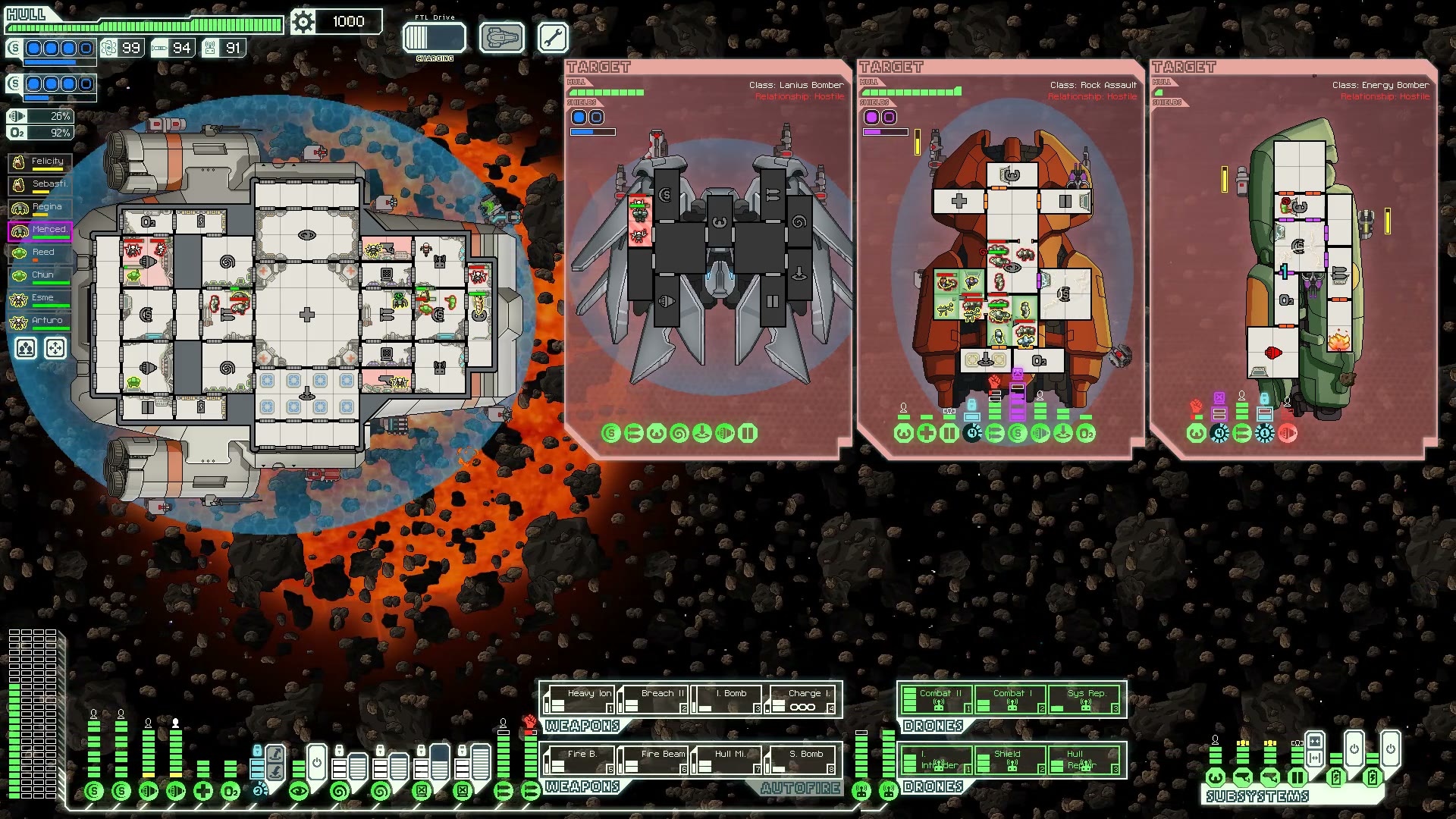
The Chonkestrel in battleWatch the Chonkestrel take on three ships at once

What's new

Compared with vanilla FTL, and with the original XFTL it's built on.

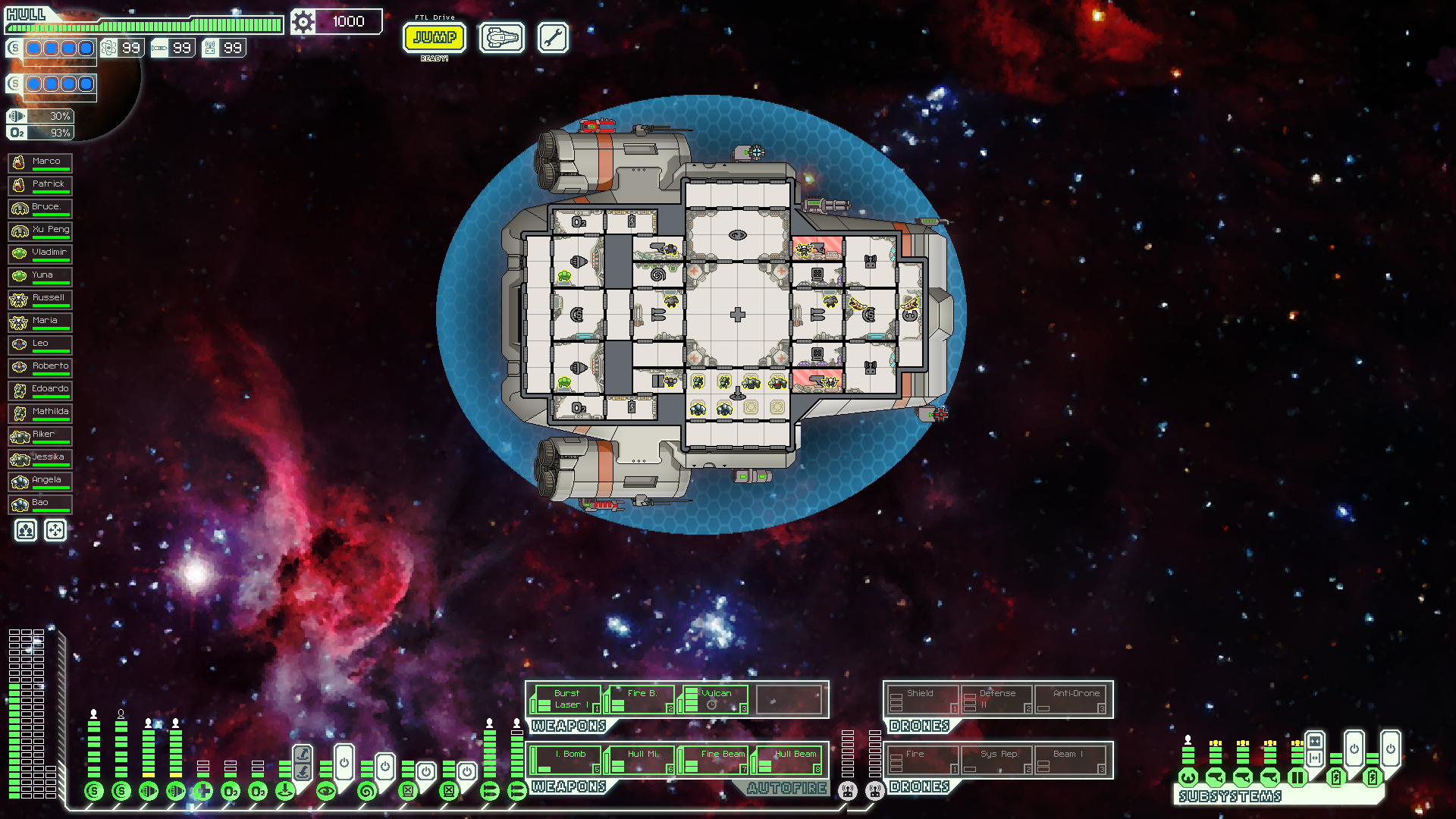
The Chonkestrel

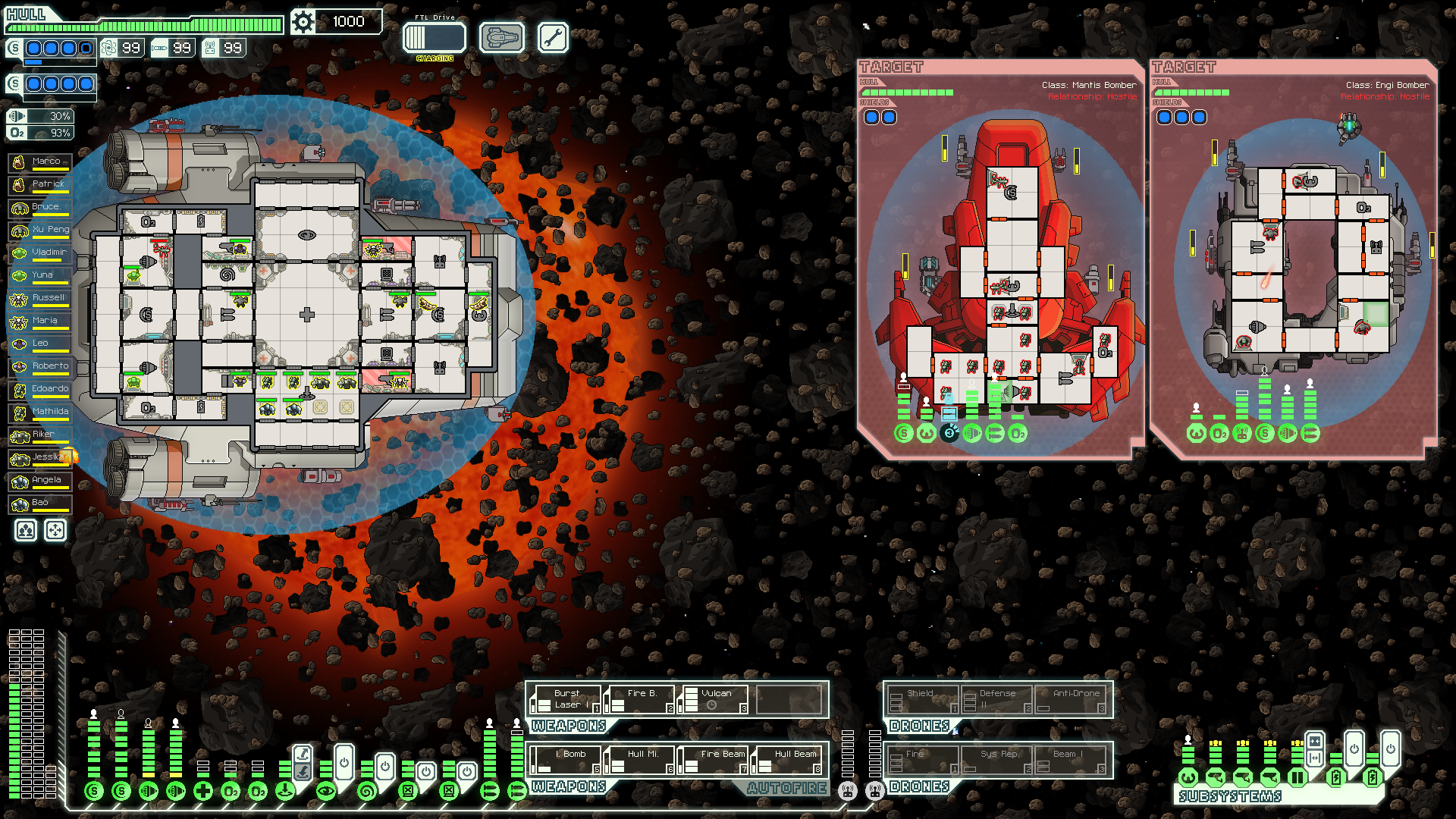
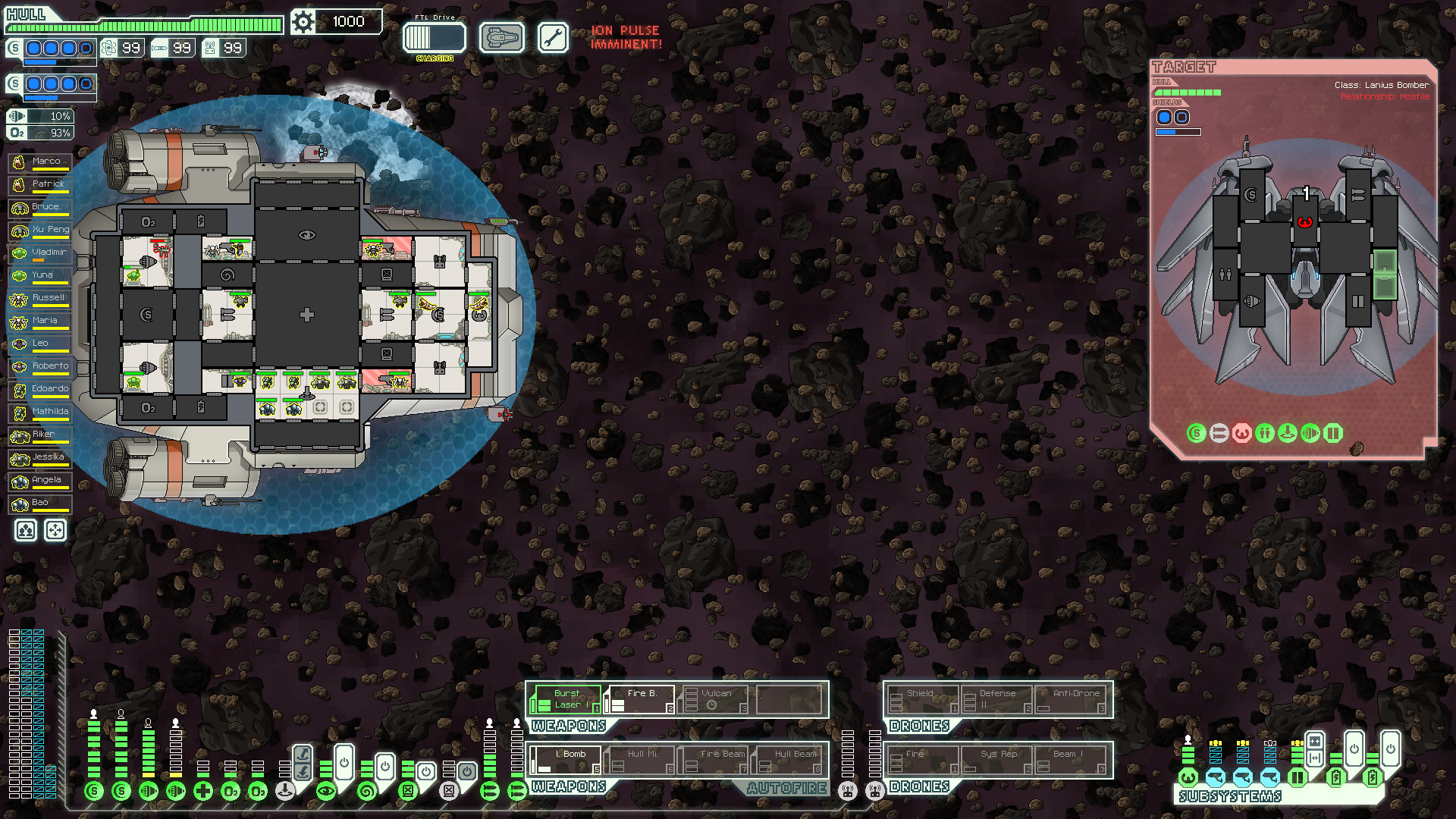
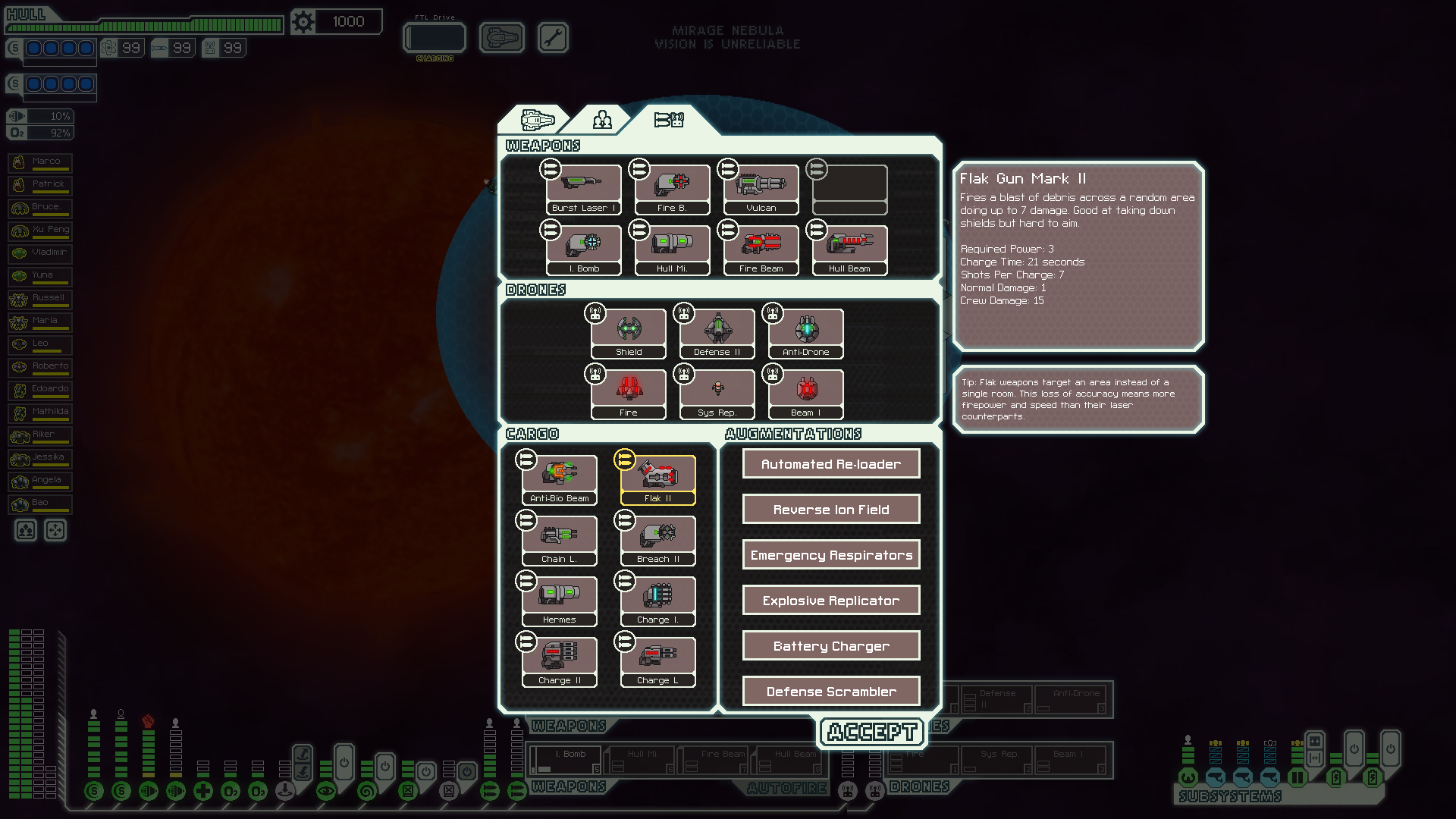
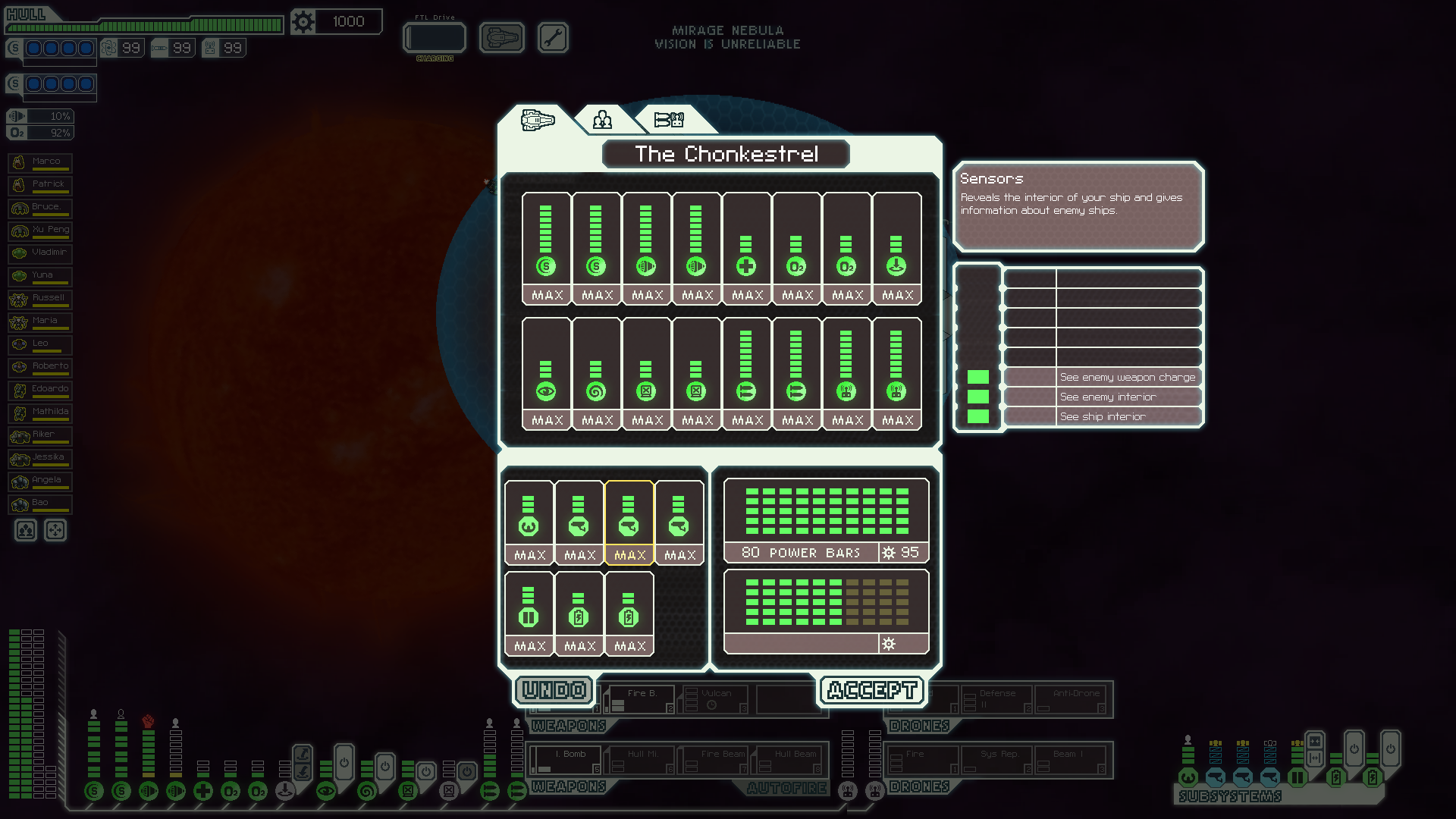
A big, symmetric take on the Kestrel, with room for 8 weapons, 6 drones, 16 crew around a 4x4 medbay, and 2 of most systems. 2Γ— the hull, but easier to hit, and it burns more fuel.

Three enemies at once

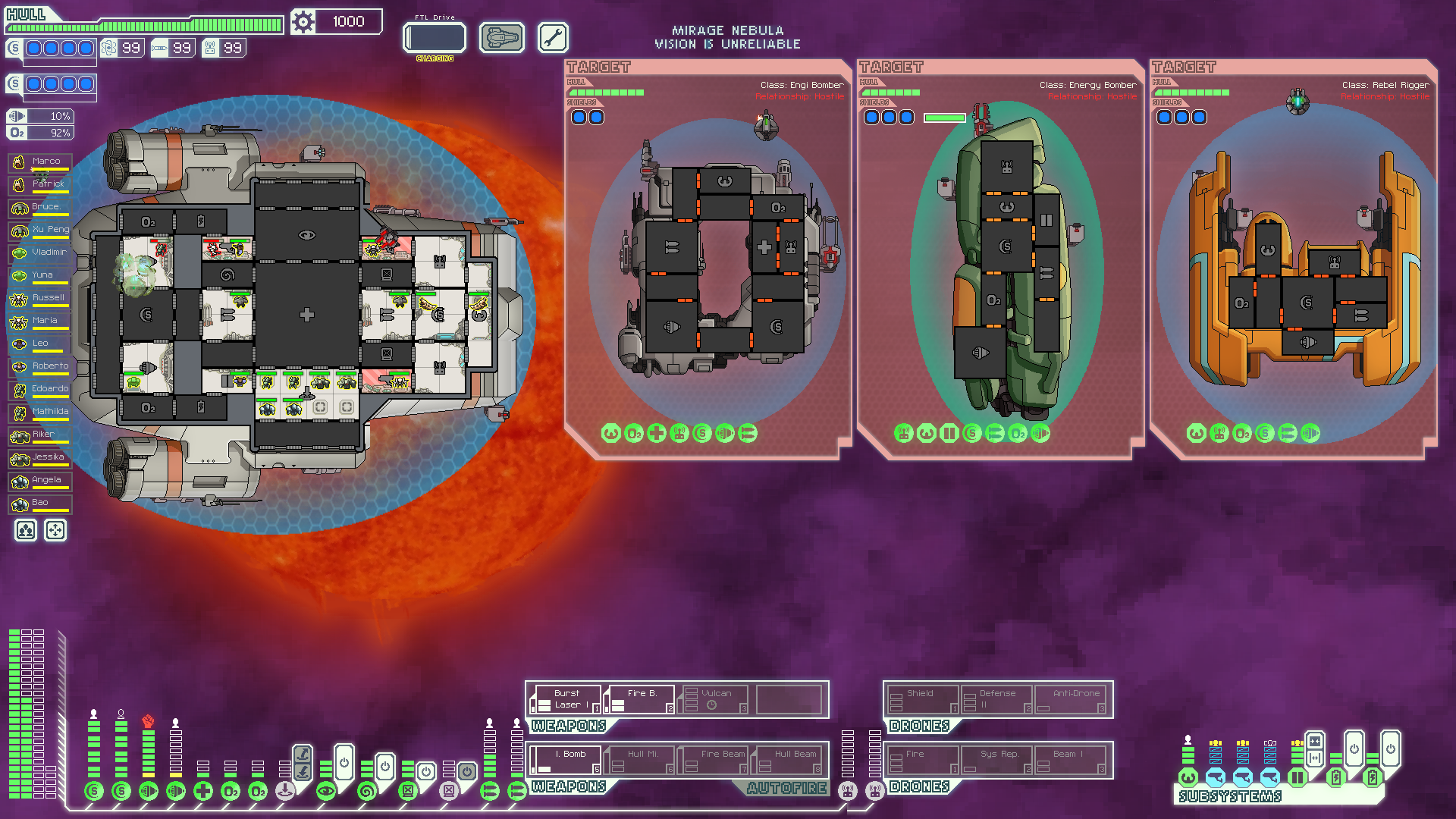
Big ships fight several enemy ships at a time, so they still get a fight: 1 at first, and up to 3 by the middle of the game. Boarding parties grow to match.

A campaign in two acts

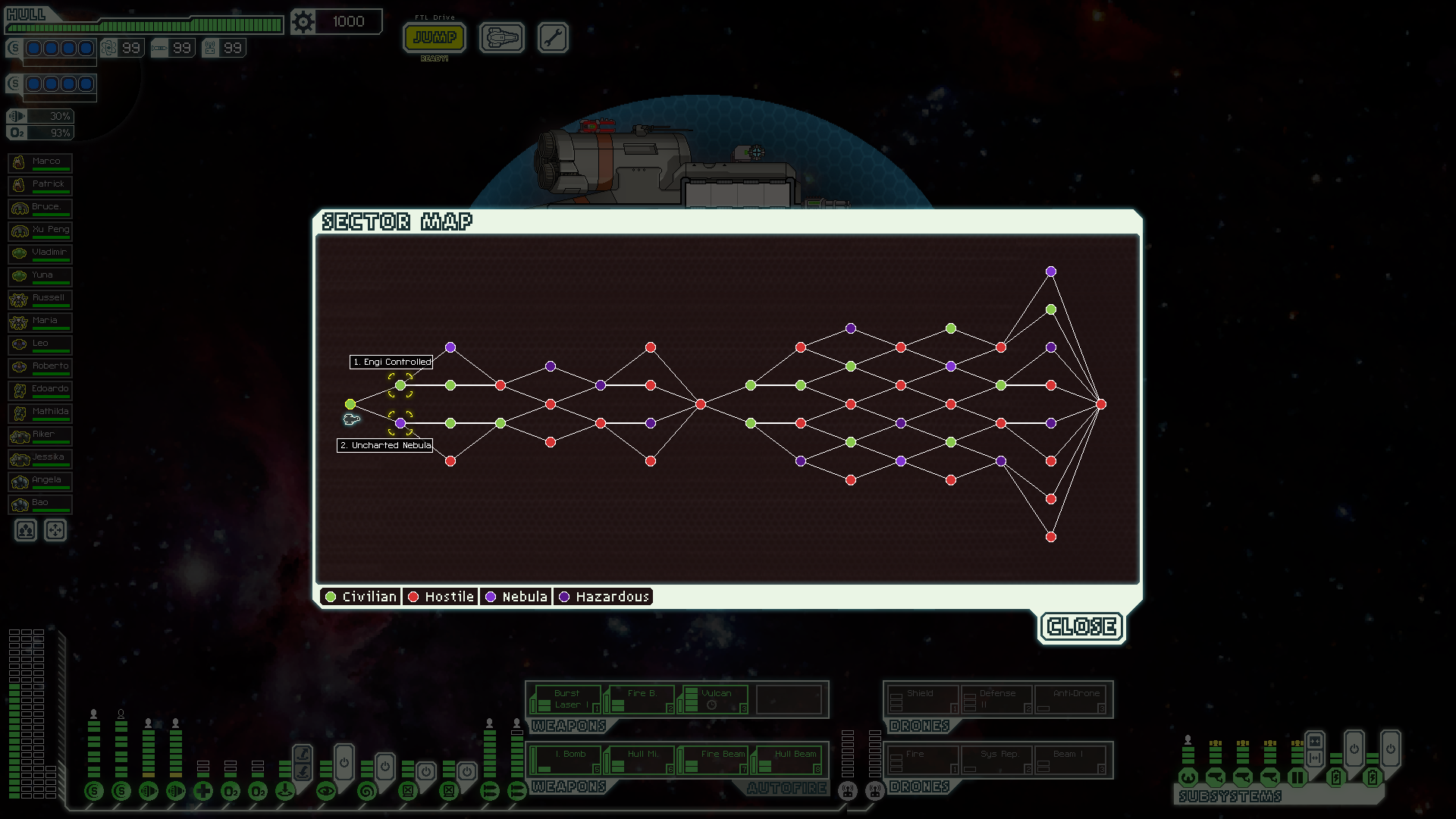
16 sectors instead of 8. Halfway through, at sector 8, every run reaches the Blockade Line, and finds out what the data you carry really is: the way to the secret shipyard of Project Chonkestrel.

New sectors

11 new sectors: the Federation Remnant, the Anvil Yards, the Rebel Heartland, the Graveyard of Giants and the Ion Storm Belt, 3 nebula sectors, and 3 hazardous ones that get deadlier through the game: the Maelstrom, the Tempest Arm and the Rift. Plus the Crystal Homeworlds on the map at last. The same sector never comes up twice in a row.

Over 140 new events

For the new sectors, for every faction's vanilla sectors, and for big ships: stations too small to dock with, Rebel battle groups, bounty hunters, and small ships to ram out of the way.

New nebulas

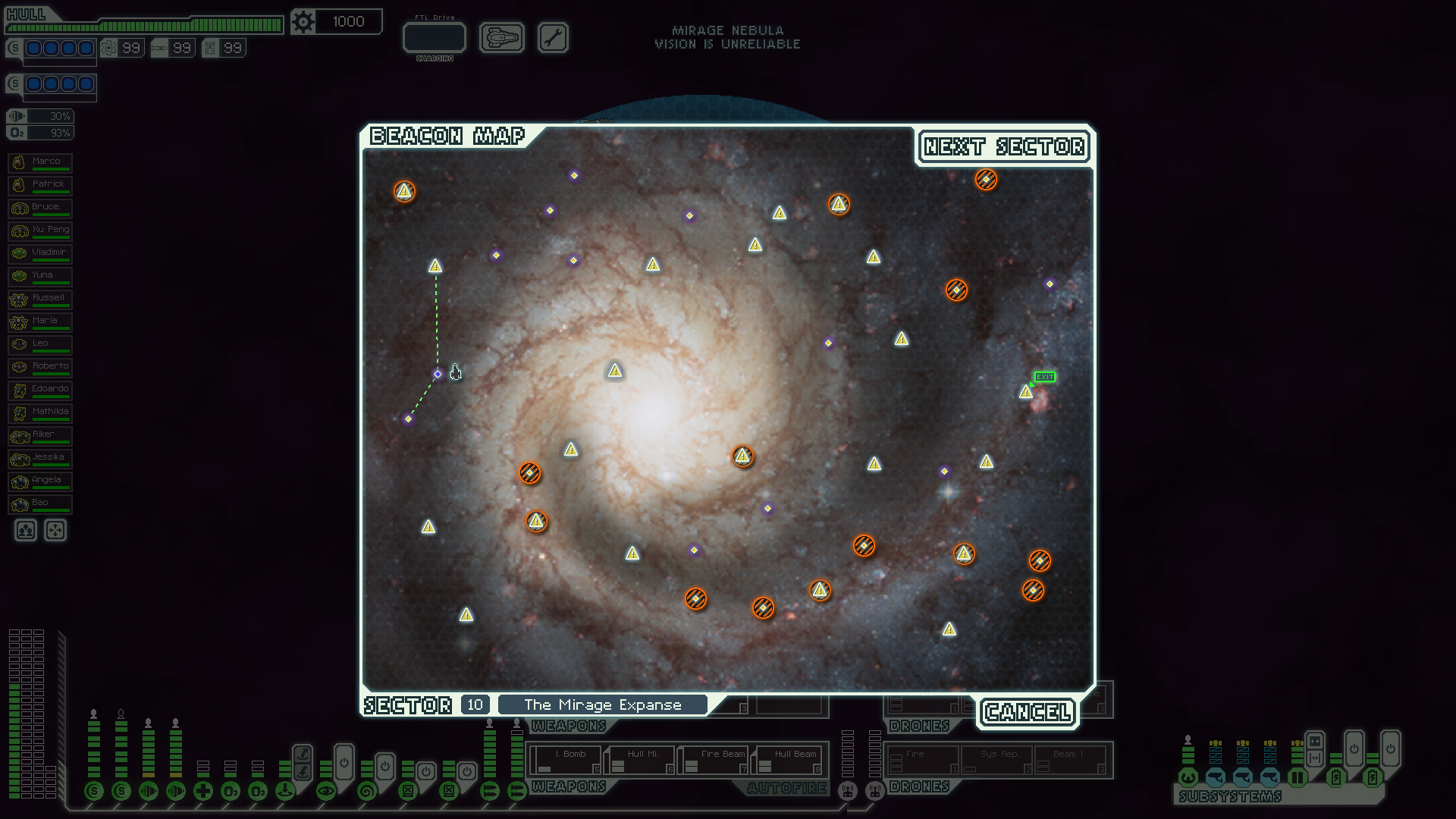
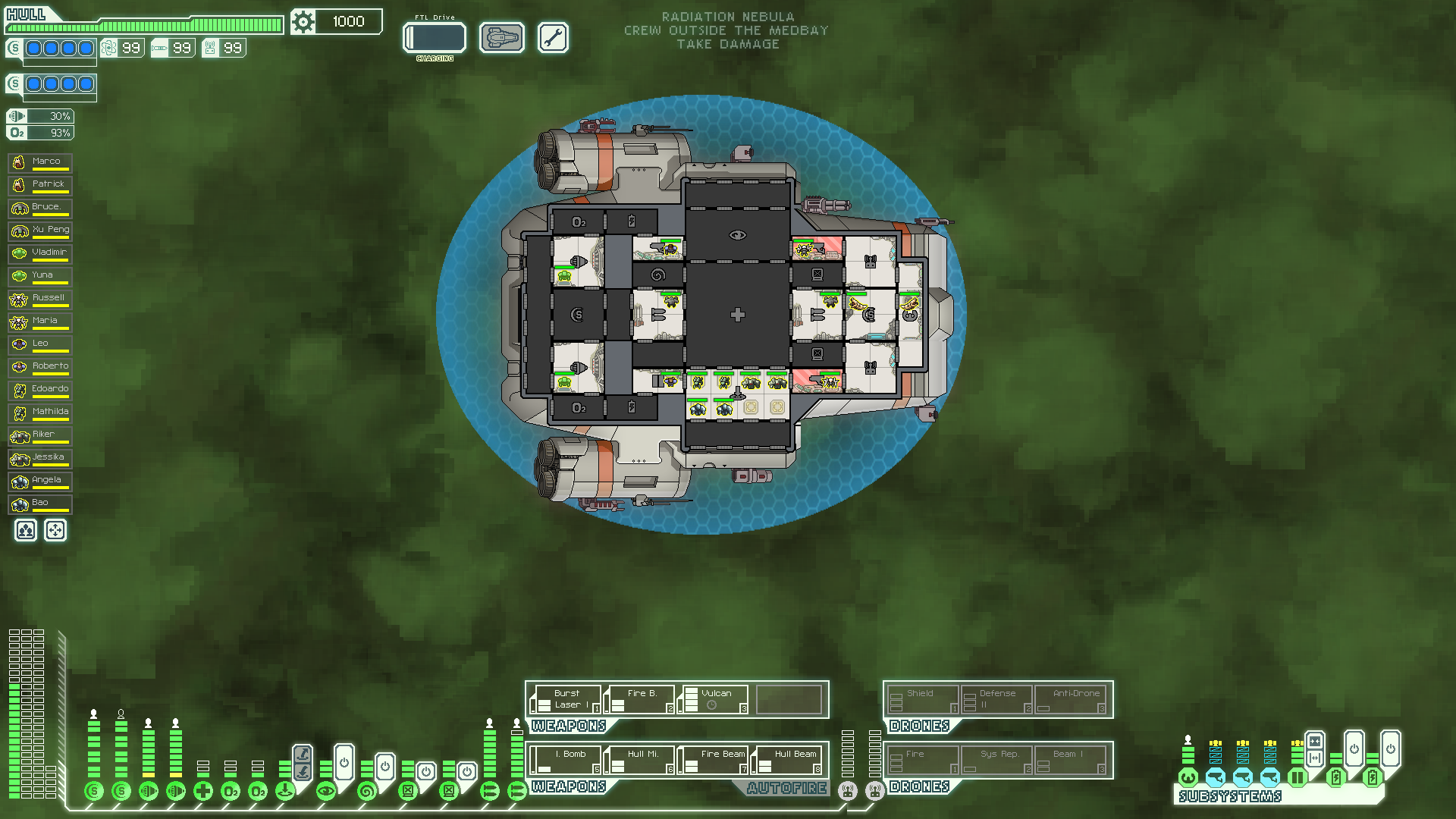
3 new kinds: radiation nebulas that hurt your crew outside the medbay, mirages that fill your map with false contacts and disguise the enemy's weapons, and dark nebulas that cut off your drones, each with a sector of its own.

Up to 4 hazards at once

Nebulas, asteroids, suns and pulsars, 2, 3 or all 4 at a beacon, in 39 combinations, with flares and pulses 2Γ— as often. Never in the first 4 sectors, and more and more often after that. In the Rift, nearly every beacon has all 4.

A tougher second act

After the blockade, asteroids come 2Γ— as often, suns start 2Γ— the fires, pulsars ion 2 systems instead of 1, and thick nebulas charge your FTL drive at 75%.

Bigger maps and stores

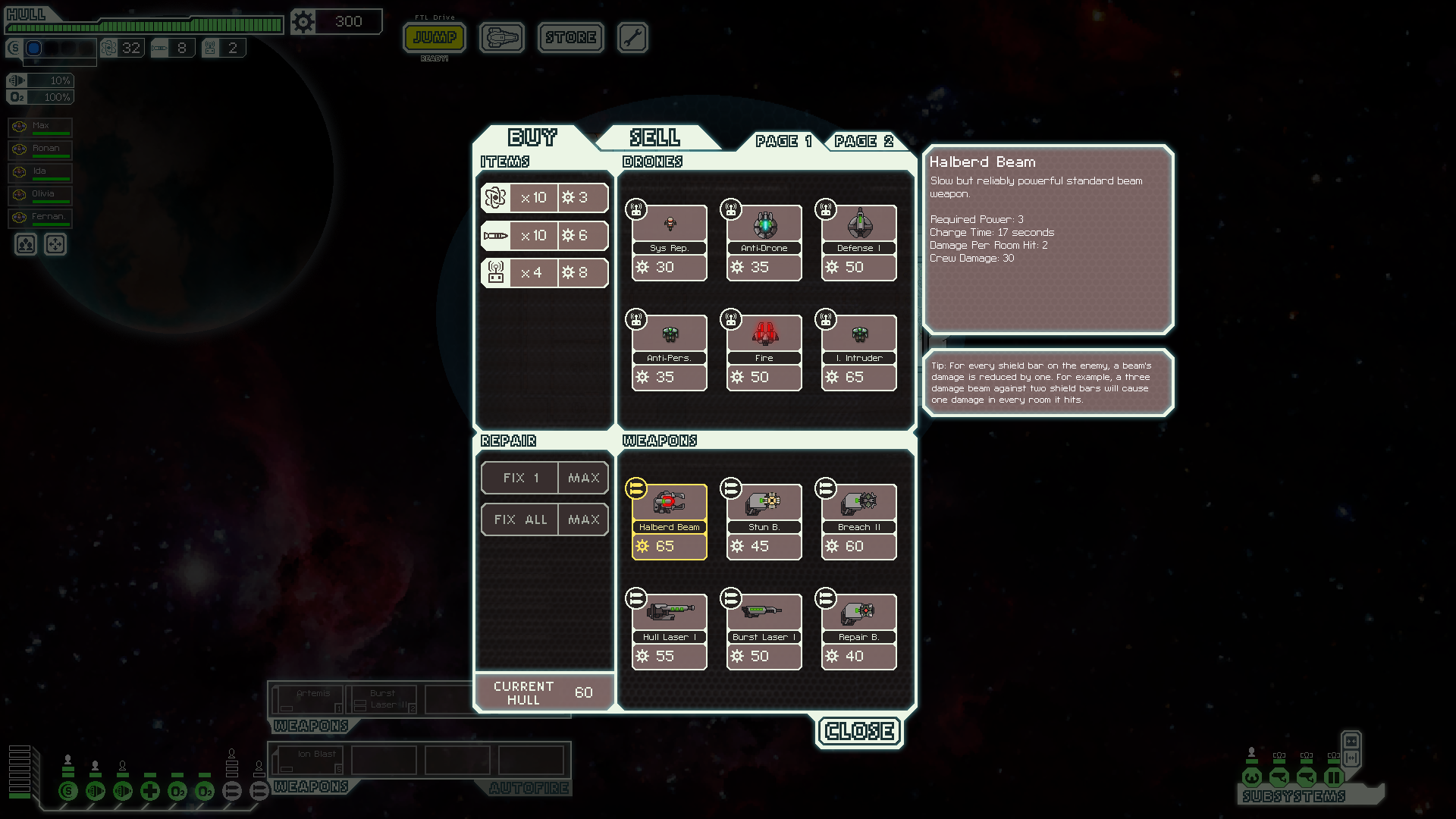
Sector maps 2Γ— the size, with about 45 beacons each, and stores with 2Γ— as many weapons, drones, augments and crew for sale.

More systems and crew

Several weapons, shields, drones, engines, oxygen, sensors, hacking, mind control and battery systems on one ship, up to 6 stacking Zoltan shields, a reactor of up to 100 power (vanilla: 25), and up to 16 crew.

Crew name sets

169 more crew names, 2Γ— as many, to go round the bigger crews, and 13 name sets to pick from: American, English, Irish, Scottish, French, Spanish, Italian, German, Russian, Chinese, Japanese, Star Wars and Star Trek.

Downloads

Free. You'll need your own copy of FTL: Faster Than Light to play: it uses the original game's data.

Version 0.3-alpha · 21 October 2026

Minimum system requirements: the same as FTL: Faster Than Light, plus a screen resolution of at least 1920×1080, to fit the big ships' interface.

Starting it on a Mac

The game isn't signed by Apple yet, so macOS asks you to allow it, once:

  1. Open the .dmg and drag Chonkestrel into Applications.
  2. Open Chonkestrel from Applications. macOS says it can't check it for malware: click Done.
  3. Open System Settings, then Privacy & Security, and scroll down to Security. Next to “Chonkestrel was blocked”, click Open Anyway, and enter your password.
  4. Open Chonkestrel again, and click Open Anyway. From then on, it opens as usual.

Starting it on Windows

  1. Right-click the .zip and choose Extract All: it won't run from inside the zip.
  2. Open the Chonkestrel folder, and run Chonkestrel.exe.
  3. If Windows says it protected your PC, click More info, then Run anyway. It's only because the game isn't signed yet.

Starting it on Linux

  1. Extract the .tar.gz, for example with tar xzf Chonkestrel-*-linux-x64.tar.gz.
  2. Open the Chonkestrel folder, and run Chonkestrel (from a terminal: ./Chonkestrel/Chonkestrel).
  3. It needs graphics drivers with OpenGL 3.3, which most have.

Screenshots

Community Feedback

β€œFTL but everything is doubled” sick project btw

u/Worldly-Mud-2600

This looks so cursed but I love it

u/SilentStorm064

I can't wait to play this beauty, well done!

u/MauriceDynasty

Amazing

u/engiewannabe

The least insane Multiverse ship

u/MaddytheBunny

Imagine being the two-man boarding crew to teleport into that medbay

u/TallBluejay824

Jesus H Christ, it has TWO weapon systems!!!

u/Dynamesmouse2

FTL big mode

u/KrimsunV

The plot thickens

u/wellthathappened43

FTL XXL

u/dumb_avali

Cooool

u/lonewolfempire

Changelog

Changelog

2026-10-21: version 0.3-alpha

  • Up to four hazards at once. A beacon can now have two (an extreme hazard), three (catastrophic) or all four (apocalyptic) of a nebula, asteroids, a sun and a pulsar at once, in 39 combinations, never two of a kind. The beacon map marks them in red, purple and cyan. They're rare early on (never all four in the first 4 sectors), and more and more common through the game: in the last sectors, most hazards come three or four at a time.
  • Two new hazardous sectors: the Tempest Arm (sectors 9-12), where most beacons have three hazards at once, and the Rift (sectors 11-15), where most have all four. The Maelstrom moves to sectors 5-8, and the three of them come at most once a game. The new nebula sectors turn up from sector 5, with hazards at every beacon. Even the most dangerous sectors have calm beacons: stores (rarer in the worst ones), quests, and a calm beacon with a special event.
  • Hazardous sectors on the sector map, in dark purple, with their own entry in the legend.
  • A bigger second act. Past the blockade, the sector map opens up to four to eight sectors a column, twice as many as act 1, for more choice of route. The vanilla civilian sectors are rare there now: the Federation's space is behind the Rebel lines.
  • Shield overchargers work. The Shield Overcharger drone used to do nothing. It now orbits the shields and recharges a row of five super-shield points, a point every 15 seconds. Each one adds a row, like a Zoltan shield, as long as it's switched on.
  • Two oxygen systems. The Chonkestrel has a second oxygen system from the start. The rooms refill at the average of the two, so losing one halves the refill (and at level 1, the other only just keeps the air in).
  • A third sensors system, to see into the third enemy ship, for sale in stores. The Chonkestrel's mind control rooms are now 2x1, to make room for it and the doors.
  • Slugs are telepathic, as in FTL: you can see into the rooms next to your slugs, even without sensors, such as in a nebula, or on an enemy ship.
  • Nebulas show they block your sensors: the sensors' icon turns blue, their power bars are crossed out, and their tooltip says why.
  • The stacked Zoltan shield panel moves under the fuel counter, next to the shields.
  • Every crew name set at once (2600 names) in the downloads, rather than just the game's own.
  • The version and build date are in the bottom-right corner.

Fixes

  • Backup batteries can't take your power past the reactor limit of 100.
  • The "paused" text no longer covers the second row of weapons boxes.
  • The highlight around a drone slot is no longer shifted to the left.
  • A ship can have at most 8 subsystems (piloting, sensors, doors and backup batteries), and the Chonkestrel at most 16 main systems.

2026-10-21: version 0.2-alpha

  • Extreme hazards: two at once. A beacon can now have two hazards at the same time, such as a nebula (of any kind) with an asteroid field, or a pulsar near a sun. Both work at once, with both their warnings, and the beacon map marks them in red, as an extreme hazard. They're as strong as act 2's hazards, and their suns flare and pulsars pulse twice as often.
  • The Maelstrom, a new act 2 sector, where a dying star, a pulsar and the wreck of a nebula churn through an old asteroid belt. Every beacon has a hazard, and about half have two, apart from the start, stores, quests and a rare calm beacon with an Engi survey station.
  • Mirage nebulas disguise the enemy's weapons. In a fight in a mirage nebula, each enemy weapon looks like a weapon of another kind, so what looks like a laser might fire missiles, and what looks like a beam might drop a bomb.
  • Autofire. The AUTOFIRE button under the weapons (or V) makes weapons keep firing at the room they're aimed at (or along the beam's line) each time they're charged, until you aim them somewhere else. Hold left Ctrl while aiming a weapon to do the opposite for just that weapon. Weapons on autofire have yellow crosshairs (and beam lines) and charge bars, as in FTL. It's saved with the game.
  • Shots fly across the whole screen. Your shots fly all the way to the screen's edge, and the enemy's come in from it, instead of vanishing and appearing in the middle of the wider screen. They fly a little faster the whole way, so they hit at the same time as before. That's every shot that flies between ships: lasers, missiles, flak, ion and asteroids.
  • Linux. A download for 64-bit Linux, with Java built in, like the others. Windows on ARM is no longer offered: the x64 download runs there.
  • A 1920x1080 window, the size the big ships' interface is laid out for, instead of one that fills the screen. On a 1920x1080 screen, it's as big as fits with the title bar and taskbar.

Fixes

  • Enemy ships start with their shields up again, as in FTL, so the weapon pre-igniter can't get a free volley in.
  • Beams no longer get stuck on the ship they hit, even across jumps: one could stay on after it had finished firing (and its weapon never fired again), or after its ship was destroyed or left while it was firing.
  • Enemy boarders no longer sometimes wait in their teleporter for good. The extra crew enemies get against a bigger ship could fill the teleporter, leaving no room for a boarder from elsewhere, whom the rest waited for. Now crew already in the teleporter board first, and the others don't wait for anyone who can't get in.
  • The log says why, when enemy boarders wait in their teleporter for a while without going.

2026-10-21: version 0.1-alpha

The first release

  • Download and play on macOS (Apple Silicon) and Windows (x64 and ARM), with Java built in, so there's nothing else to install. You need your own copy of FTL.
  • Finds your copy of FTL from Steam, GOG or Epic Games, the FTL app on macOS, or next to the game. If it can't, drop ftl.dat onto its window, or choose it.
  • Starts straight away with the Chonkestrel.
  • Saves your game after every jump and when you quit, and carries on from there the next time, as in FTL.
  • Checks your screen is big enough for the Chonkestrel's interface (1920x1080), and tells you if it isn't, instead of starting a game that doesn't fit.
  • A log of each game, to send with bug reports.

Fixes

  • The game starts on more graphics cards and drivers.
  • With three enemy ships, the rightmost one's weapon bars stay on the screen.

2026-10-20

A longer, richer campaign

  • Two acts. The sixteen-sector game is now a story in two halves. Halfway through, every game reaches the Blockade Line, where the Rebels try to stop you finding out what the data you carry really is: the location of the Anvil Yards, the secret shipyard of Project Chonkestrel. Its exit is guarded by the blockade's command ship.
  • Five new sectors for the second act:
    • Federation Remnant: cut-off colonies with drydocks, volunteers and armouries.
    • The Anvil Yards: the hidden shipyard, with a free refit for your ship.
    • Rebel Heartland: checkpoints, propaganda relays, prison transports and the Rebels' home guard.
    • Graveyard of Giants: the wrecks of the war's capital ships, full of salvage and the things guarding it.
    • Ion Storm Belt: permanent ion storms, ambushes and smugglers.
  • The Crystal Homeworlds can now turn up in the second act.
  • No more repeats. You won't get the same kind of sector twice in a row, or the same choice twice at a fork.
  • About 140 new events: for the new sectors, for every faction's vanilla sectors (mostly in the second act, so the first half still feels like vanilla FTL), and for big ships like the Chonkestrel. Many of them have several versions of their text.
  • Tougher second act. Asteroid fields, suns and pulsars are stronger, and nebulas are thicker, so FTL drives charge slower in them.

New nebulas

  • Radiation nebulas (green) slowly hurt any crew outside the medbay.
  • Mirage nebulas (purple) fill your map with ships and hazards that aren't there.
  • Dark nebulas (dark grey) cut off your drones, as well as your sensors.
  • Each has a sector of its own, where most of the beacons are that kind of nebula: the Radiation Fields, the Mirage Expanse and **the Dark Reach**. They also turn up among ordinary nebulas everywhere else.
  • A warning tells you what kind of nebula you've just arrived in.

The Chonkestrel

  • Fights up to three ships at once, starting with one at a time in the first sector, and growing to three by the middle of the game. It sits in the middle of the screen when there's no fight.
  • Twice the hull, split into half-cells on the hull bar, but it's easier to hit.
  • Uses two fuel a jump, but starts with twice as much.
  • Two sensors systems, each seeing into a different enemy ship.
  • Its own events: stations too small to dock with, crowds cheering a Federation cruiser, towing freighters, Rebel battle groups and bounty hunters sent after it, and ramming small ships out of the way.
  • Rewards and costs that grow with the ship, such as repairs and supplies in the new events.
  • Leaves a wake through nebulas, so they slow the Rebel fleet down less when you're flying it.
  • Shown first in the ship list, with an outlined miniature.
  • A new picture for its wider cloaking room.

Crew names

  • 169 more crew names, twice as many as the game had, to go round the bigger crews.
  • Name sets to pick from: American, English, Irish, Scottish, French, Spanish, Italian, German, Russian, Chinese, Japanese, Star Wars and Star Trek, with 100 male and 100 female names each.

Interface

  • Tooltips on the beacon map, as in vanilla: hover over a beacon to see what's there and what kind of hazard it is.
  • Tooltips on the sector map: hover over a sector to see what type it is.
  • The extra sensors systems are grouped together in the subsystems panel.

2026-10-19

Bigger ships

  • The Chonkestrel, a big, symmetric take on the Kestrel, as a ship of its own, picked by default in the hangar (the vanilla Kestrel is still there). It has room for 8 weapons, 6 drones, two of most systems, 16 crew around a 4x4 medbay, 8 cargo and 6 augments.
  • Ship sizes. Big ships fight two copies of each enemy ship at once, so they still get a fight, and enemy boarding parties are bigger against them, from two to four times by the end of the game. The Rebel flagship is as big as the Chonkestrel, so it fights it alone.
  • Big ships dodge worse. Their evasion comes from their weakest engine, so the Chonkestrel needs both of its engines upgraded, and cloaking helps them less.
  • A reactor of up to 100 power, shown in narrower columns.

More of everything

  • Several shields systems, whose layers stack.
  • Several drones systems, each with three drone slots, all shown in the hangar.
  • Several hacking, mind control and battery systems.
  • More cargo and augments, and Zoltan shields that stack, up to six, with a panel showing each one.
  • Sixteen sectors a game, twice as many as vanilla, with more sectors to choose from at each step.
  • Sector maps twice as big, with twice as many events, and a slower Rebel fleet.
  • Stores twice as big, with twice as many items in each section.
  • The numbers on the targeting crosshairs for weapons 5 to 8 no longer overlap.

2026-10-18

  • The window fills the screen, with the backgrounds scaled to fit.
  • Several weapons systems per ship, with up to eight weapons, and hotkeys for weapons 5 to 8.
  • Up to sixteen crew, with hotkeys for crew 9 to 16.

Support the project

Project Chonkestrel is made for fun, and free. If you enjoy it and want to help, thank you!

Crypto

Bitcoin (BTC)

bc1qxnw60rrmgt2xzfv0nc5j4mt4zeetqswp0vcth4

Ethereum (ETH)

0xFeb1329a68E7e754FbA545980Bf3f287f9919F50

Solana (SOL)

Af4xBSkmu2AeqQnT9bn65VgtKdoRXv6xXyhQTEbj7ao8

TRON (TRX)

TCehM6UMMwMjoY36k9fiVv63Lzpr5aFvcv

Dogecoin (DOGE)

DFGkHgqvKZNxsoraPHmzBRHhKwr6XqBAfg

Zcash (ZEC)

t1VmEi2isZooMvon33AvcFZvHUhgFBSRKrF

Gram (GRAM)

UQAG6jk3QnecTLsw-oGnXoZ3NsBfc4mtcTWM9mWd9rh8wqjg